Wired Different: Why Extreme Sports Athletes Are Quietly Dominating High-Volatility Casino Games
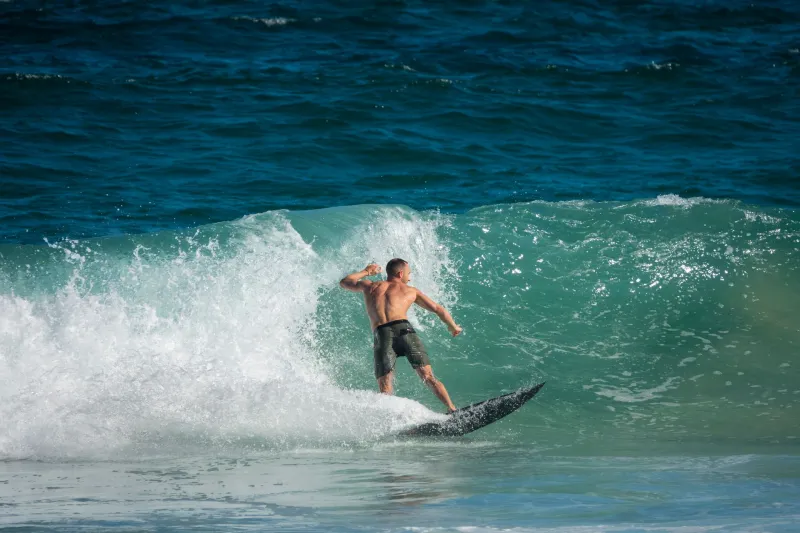
There's a certain type of person who looks at a 50-foot wave and thinks, yeah, I'll take that. The same type who stares down a 20-metre motocross gap, commits to the throttle, and trusts their body to handle whatever comes next. These are not reckless people. They're calculated. They've trained their nervous systems to process chaos faster than most of us can blink — and as it turns out, that skill set transfers in ways the broader gambling world hasn't fully cottoned on to yet.
Australia's extreme sports scene — surfing, skateboarding, motocross, BMX, big mountain snowboarding — is quietly producing a cohort of casino players who aren't just holding their own. They're thriving. Particularly in high-volatility pokies and fast-paced live dealer environments where emotional discipline and pattern recognition matter more than luck ever will.
We spoke to athletes, dug into the psychology, and came back with something genuinely interesting.
The Risk Tolerance Myth
Let's kill a misconception straight away: extreme sports athletes aren't reckless gamblers who throw money around because they're used to chaos. That's the outsider take, and it's wrong.
Jake Morrow, a semi-professional motocross rider from Toowoomba who asked us to use a pseudonym, put it plainly: "People think because I jump bikes for fun that I don't think about risk. Mate, I think about risk more than anyone. Every single jump is a calculation. What's the landing like? What's the wind doing? Am I warmed up enough? You don't survive this sport by being careless."
That's the key insight. Extreme sports don't attract people who ignore risk — they attract people who've learned to quantify risk faster and more accurately than average. The difference between a reckless gambler and a sharp casino player is the same difference between a rookie who tries a double backflip on a whim and a seasoned rider who's drilled the progression for two years before committing. One is gambling blindly. The other is operating within a calculated framework.
When Jake plays high-volatility pokies — the kind with massive variance, long dry spells, and occasional enormous payouts — he approaches them the same way he approaches a new track. "I watch it first. I figure out the rhythm. I set a limit for what I'm willing to lose before I even spin, and I stick to it. It's just risk management. Same as every weekend."
Pattern Recognition Under Pressure
Surfers, specifically, seem to have a disproportionate edge in casino environments — and the reason comes down to one thing: they're extraordinarily good at reading patterns in chaotic systems.
Ocean waves don't follow a script. Swells arrive in sets, shift with wind changes, and behave differently depending on the reef or sandbar underneath. Elite surfers spend years developing the ability to read these patterns in real time, often making positioning decisions seconds before a set arrives. It's an unconscious, deeply trained skill — and it maps surprisingly well onto reading variance in high-volatility games.
Ash Connelly, a former competitive surfer from the Gold Coast who now works in digital marketing and plays casino games recreationally, described the connection without even being prompted: "When I'm playing a pokie with big variance, I can feel when a dry run is just variance versus when something's actually off. I don't know how to explain it scientifically. It's just pattern awareness. Same thing I used to use to pick sets from the back of the lineup."
Now, to be clear — pokies run on random number generators. There's no pattern to predict in the way a wave can be predicted. But what Ash is describing is something slightly different: the psychological tolerance for variance, and the ability to distinguish between a normal cold streak and a sign that your strategy needs adjusting. That distinction is enormously valuable in high-volatility environments where inexperienced players often panic-bet or abandon a session right before a machine enters a hot cycle.
Emotional Regulation as Competitive Advantage
Ask any sports psychologist what separates elite extreme sports athletes from the rest, and emotional regulation will be near the top of the list. The ability to stay composed mid-air, mid-wave, or mid-race — when your body is screaming danger signals — is a trained capacity that takes years to develop.
In casino gaming, that same capacity is worth its weight in gold.
Tilt — the phenomenon where a losing streak causes a player to make increasingly irrational decisions — is the single biggest destroyer of casino bankrolls. It's not bad luck. It's bad emotional management. Players who can stay composed after a string of losses, stick to their system, and avoid the urge to chase are the ones who walk away with their bankroll intact and, occasionally, significantly richer.
Extreme sports athletes, particularly those who've competed at a serious level, have usually been through some version of adversity training. They've crashed. They've lost competitions after years of preparation. They've had to get back on the bike, or the board, or back in the water, and perform again. That resilience doesn't evaporate when they sit down at a casino.
Morrow again: "I've had bad sessions. Everyone does. But I never chase. The moment I feel that urge — that I need to win this back feeling — I close the tab. That feeling is what gets people hurt, whether it's on a track or at a table."
The Bankroll-to-Budget Parallel
Here's something the broader gambling community doesn't talk about enough: extreme sports athletes are, by necessity, meticulous budget managers. Sponsorship money is inconsistent. Travel costs are enormous. Equipment is expensive. A professional or semi-professional athlete who can't manage a budget doesn't last long in the sport.
That financial discipline carries over directly into how they approach casino gaming. The athletes we spoke to universally described having hard limits, session budgets, and a clear separation between gambling funds and living expenses. None of them described gambling as a primary income strategy — they treated it as entertainment with a disciplined financial structure around it.
This is, frankly, how everyone should be approaching casino gaming. But for athletes who've spent years managing tight budgets and unpredictable income streams, it comes naturally.
Does the Edge Actually Hold Up?
Let's be honest about the limits here. High-volatility pokies are still games of chance. No amount of pattern recognition changes the RTP. No emotional regulation shifts the house edge. What these athletes have isn't a cheat code — it's a set of psychological tools that help them play smarter, last longer, and avoid the catastrophic mistakes that bleed most recreational players dry.
The edge is real. It's just not magical.
What it comes down to is this: the skills that make someone exceptional in extreme sports — risk quantification, emotional regulation, pattern awareness, financial discipline — are exactly the skills that make someone a smarter casino player. Australia's extreme sports athletes didn't set out to become sharp casino punters. They just brought the same mindset they use everywhere else, and it turns out that mindset is genuinely valuable.
For the rest of us, the takeaway is clear. You don't need to be dropping into massive surf or launching off a motocross ramp to borrow these principles. You just need to start treating your casino sessions with the same respect, preparation, and discipline that an athlete brings to their sport.
Go hard. But go smart.