Pattern or Punter's Curse? Separating Real Table Game Strategy from Casino Mythology
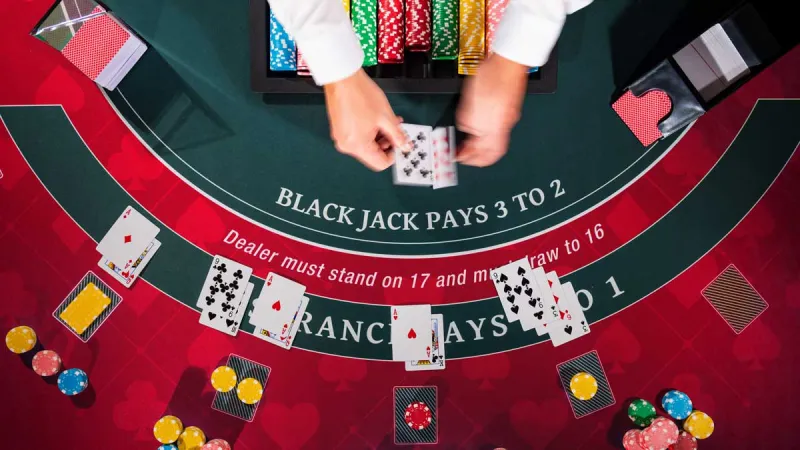
Photo: blackjack baccarat table game cards chips casino strategy, via a.storyblok.com
Sit at a baccarat table long enough and you'll see it. Someone pulls out a card, starts tracking results in a grid, circles clusters of banker wins, and nods knowingly at the pattern unfolding before them. At the roulette wheel, a bloke next to you hasn't bet in twenty spins — he's waiting for the right moment, convinced a sequence of reds means black is overdue.
Are they onto something? Or are they just very confident about being wrong?
This is the central question for any serious table game player: what actually constitutes a meaningful pattern, and what's just noise your brain has dressed up to look like signal?
Why the Human Brain Is Terrible at Random
Before we get into game-specific strategy, let's deal with the uncomfortable truth. The human brain is spectacularly bad at recognising genuine randomness. We are wired — evolutionarily, neurologically — to find patterns. It's what kept our ancestors alive. Spot the pattern in the tall grass, survive. But that same instinct, applied to a shuffled deck or a spinning wheel, produces something researchers call the clustering illusion: the tendency to see meaningful patterns in data that is, in fact, random.
A run of six banker wins in baccarat feels significant. Statistically, it's not. With roughly 50/50 odds (ignoring the tie), a run of six is expected to occur naturally once every 64 sequences. It will happen. It means nothing about what comes next.
This is the foundation on which a lot of table game mythology is built — and it's the first thing any sharp Australian punter needs to demolish before they sit down.
Blackjack: Where Pattern Recognition Actually Has a Job
Of all the major table games, blackjack is the one where skill and pattern recognition have genuine, mathematically supported value. Not because you can predict cards, but because the composition of the remaining deck actually changes the odds in real time.
Card counting — the practice of tracking the ratio of high to low cards remaining — is not magic or cheating. It's applied probability. When the deck is rich in tens and aces, the player has a statistical advantage. When it's depleted of high cards, the house edge increases. A player using even a basic Hi-Lo counting system can reduce the house edge from around 0.5% to, in favourable conditions, a slight player advantage.
Here's a simplified version of how it works in practice:
- Assign +1 to low cards (2–6), 0 to neutral cards (7–9), and -1 to high cards (10–Ace)
- Keep a running count as cards are dealt
- When the count is strongly positive, the deck favours the player — increase your bet
- When it's negative, the house has the edge — pull back
This isn't a guaranteed win system. It's a method for identifying when the mathematical environment tilts slightly in your favour and exploiting those moments. Over thousands of hands, it shifts the expected outcome.
Note: most Australian casinos — online and physical — use continuous shuffle machines or six-to-eight deck shoes with frequent reshuffles specifically to neutralise counting. Know your table before you commit a strategy.
Baccarat: The Myth-Riddled Table
Baccarat is arguably the most mythology-soaked game in any casino. The roadmap cards, the pattern tracking, the "dragon" and "panda" side bets — baccarat has an entire culture built around pattern recognition that has essentially zero statistical foundation.
The honest breakdown: baccarat is almost entirely a coin flip. Banker wins approximately 45.8% of the time, Player wins approximately 44.6%, with ties making up the rest. Banker is the marginally better bet due to slightly lower house edge (1.06% vs 1.24% for Player), but neither outcome is influenced by previous results.
The roadmap systems — Big Road, Bead Road, Big Eye Boy — are popular in Asian gambling culture and have genuine entertainment and engagement value. But they do not improve your odds. The pattern you're tracking on that card does not affect the next shuffle.
The sharpest move a baccarat player can make is simple: always bet Banker, never bet Tie (house edge of 14.4%), set a hard stop-loss, and ignore the roadmap entirely.
Roulette: The Gambler's Fallacy Playground
Roulette is where the gambler's fallacy lives rent-free. The fallacy: if red has come up eight times in a row, black is "due."
It isn't. Every spin of a European roulette wheel is an independent event with a 48.6% chance of red and 48.6% chance of black (the green zero is the house's cut). Previous results have zero mathematical relationship to future spins. The wheel has no memory.
That said, there are a couple of genuine considerations for roulette players:
European vs American wheel: European roulette has a single zero, giving a house edge of 2.7%. American roulette adds a double zero, pushing the house edge to 5.26%. If you're playing roulette, always choose European where available. That's not a pattern — that's just picking the better game.
Biased wheels: In physical casinos, mechanical imperfections can occasionally cause genuine statistical bias toward certain numbers or sectors. Serious advantage players have historically tracked thousands of spins to identify these. In modern, well-maintained casinos (and all online casinos), this is essentially non-existent. Don't build a strategy around it.
What Responsible Pattern Recognition Actually Looks Like
Here's the practical framework for Australian table game players who want to think clearly:
- Distinguish between games of skill and games of pure chance. Blackjack rewards skill. Baccarat and roulette largely do not. Apply effort accordingly.
- Track your own behaviour, not the board. The most useful pattern to monitor is your own betting discipline — how you respond to winning streaks, how you react to losses.
- Use strategy cards in blackjack. Basic strategy charts reduce the house edge to its theoretical minimum. Most casinos allow them at the table. Use one.
- Set a session budget and a stop-win target. Knowing when to leave is a pattern too — and it's the one that actually protects your bankroll.
- Be sceptical of any "system" that claims to overcome the house edge through betting progression. Martingale, Fibonacci, D'Alembert — these are bankroll management styles, not edge creators. They change how you lose, not whether you do.
The Real Edge
The truth is that in most table games, the house always holds some mathematical advantage that no pattern recognition can fully overcome. But the gap between a disciplined, informed player and an impulsive, mythology-driven one is enormous — not necessarily in win rate, but in how long your money lasts, how often you leave with something, and how much you enjoy the experience.
Knowing which patterns matter and which ones are just your brain telling stories? That's the closest thing to a genuine edge most of us will ever have.
If gambling is causing you stress or financial difficulty, reach out to Gambling Help Online at 1800 858 858. It's free, confidential, and available any time.